The Silent Inheritor
Listen This Story
The fog rolled off the Atlantic like a living thing, thick and tasting of brine, as it swallowed the winding driveway of Hawthorn House. Elara gripped the steering wheel of her rental car, her knuckles white. She wasn’t just driving into a storm; she was driving into a past she hadn’t known existed until a week ago.
Elara was twenty-eight, a linguistic anthropologist at the University of Chicago. Her life was defined by structure, syntax, and the rigid rules of grammar. She made sense of the world by categorizing it. But the letter she had received from the solicitor had defied categorization. Her father, a man of few words who had passed away earlier that year, had never spoken of his mother. Elara had assumed she died decades ago. Instead, Isolde Vance had died only last month, leaving her entire estate—specifically, this monstrosity of a Victorian Gothic manor on the jagged coast of Maine—to the granddaughter she had never met.
The car crunched to a halt over the gravel. The house loomed, a dark silhouette of turrets and widow’s walks against the bruising purple sky. It looked less like a home and more like a fortress built to keep something out. Or keep something in.
The Arrival

The key was heavy, cold iron that smelled of rust. It turned in the lock with a groan that echoed through the cavernous foyer. Elara stepped inside, flipping a switch. A crystal chandelier flickered to life, casting fractured light over dust-sheeted furniture that looked like crouching ghosts.
For the first two days, Elara simply existed in the space. She explored the library, filled with rotting classics, and the kitchen, where a 1950s calendar still hung on the wall. The house felt suspended in time, holding its breath. It was on the third afternoon, while chasing a draft that whistled through the second-floor hallway, that she found the anomaly.
At the end of the east wing corridor, behind a heavy velvet curtain that she initially thought covered a window, was a door. It had no handle. Only a keyhole. The solicitor had given her a ring of keys, most of which she hadn’t used. She tried three before a small, brass key—distinctly different from the iron ones—slid in.
The Chamber of Ink
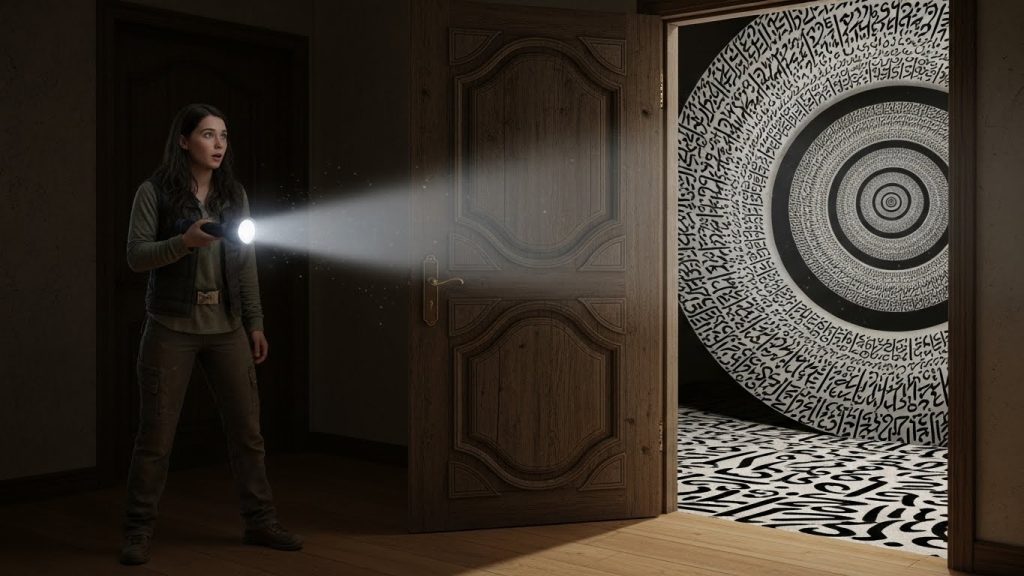
Elara pushed the door open and clicked on her flashlight. The beam cut through the stagnant air, illuminating a circular room located within one of the turrets.
She froze.
The room was empty of furniture. There was no bed, no chair, no rug. But the room was not empty.
The walls.
From the crown molding to the baseboards, every inch of the plaster was covered in writing. It wasn’t the chaotic scrawl of a madman, nor the vandalism of a squatter. It was calligraphy. Precise, elegant rows of black ink spiraled around the room.
Elara stepped closer, her heart hammering a frantic rhythm against her ribs. She raised the light to eye level. As a linguist, she had studied everything from Linear B to forgotten Amazonian dialects. She knew the shape of language. She recognized the cadence of vowels and consonants.
But she could not read this.
The symbols were sharp, angular, interspersed with flowing, vine-like curves. It looked like a hybridization of Ogham script and musical notation. It was beautiful, terrifying, and utterly alien.
The Obsession Begins
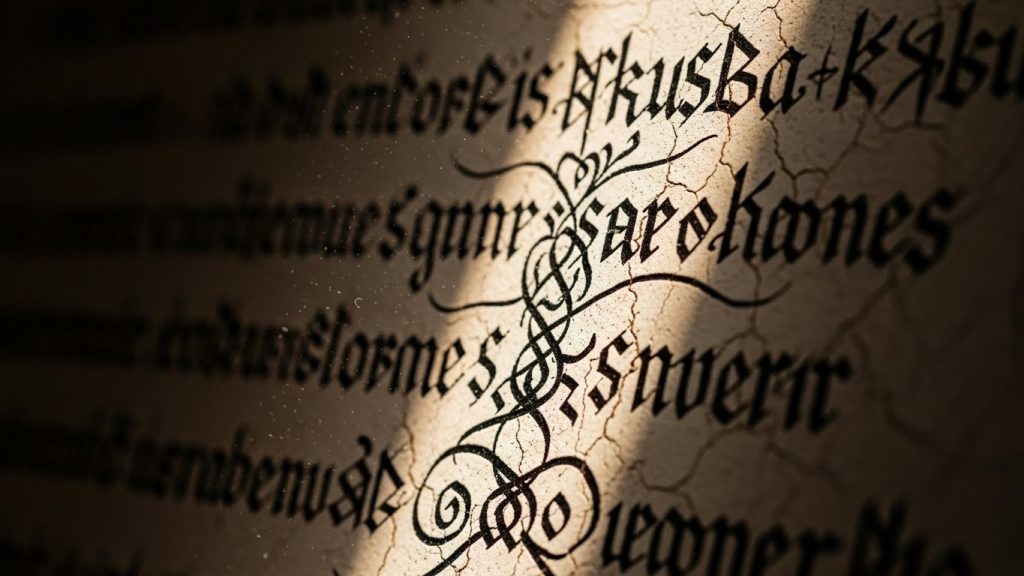
Elara spent the next week camping in the hallway outside the room. She set up high-intensity work lamps that flooded the turret with clinical white light. She photographed the walls, panel by panel, stitching them together on her laptop to create a digital panorama.
She ran the symbols through the university’s pattern-matching software. She cross-referenced them with Tolkien’s Elvish, with the Voynich Manuscript, with shorthand codes used by spies in the Cold War.
Nothing matches.
“It’s an idiolect,” she whispered to herself on the fifth night, her eyes red-rimmed from staring at the screen. “Or a constructed language. A conlang.”
Isolde Vance, the grandmother she never knew, hadn’t just written on the walls. She had invented a language to do it.
Frustration began to gnaw at Elara. Why? Why invent a language just to talk to yourself? A language is a bridge; it requires a speaker and a listener. A language of one is a paradox. It is a wall.
She began to look for the “Rosetta Stone.” If Isolde had expected anyone to read this, there had to be a key. If she hadn’t… then Elara was staring into the abyss of a lonely woman’s mind.
The Architecture of Memory
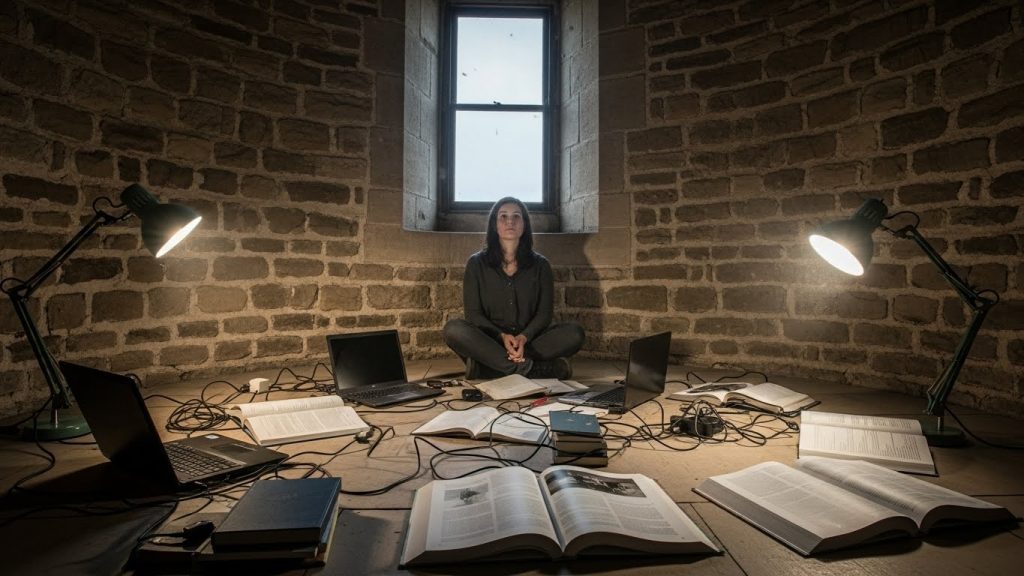
Elara abandoned the computer and went back to the physical house. She stopped looking at the text and started looking at the context. She noticed that the writing changed texture around the room.
On the eastern curve of the wall, the ink was faded, the strokes tentative. On the southern curve, the writing was bold, angry, the nib of the pen digging deep into the plaster. On the west, the script became shaky, brittle, the lines drifting downward.
It was chronological. East was the beginning. West was the end.
She focused on the East wall. At the very bottom, near the floorboards, she found a single line of text that wasn’t in the alien script. It was in French.
Le silence est le seul mensonge qui ne trahit pas. “Silence is the only lie that does not betray.”
And below it, a date: 1964.
The year her father was born.
Elara sat back on her heels. 1964. The writing began with her father’s birth. The creation of this language coincided with the arrival of the son Isolde would eventually become estranged from.
The Gardener’s Clue
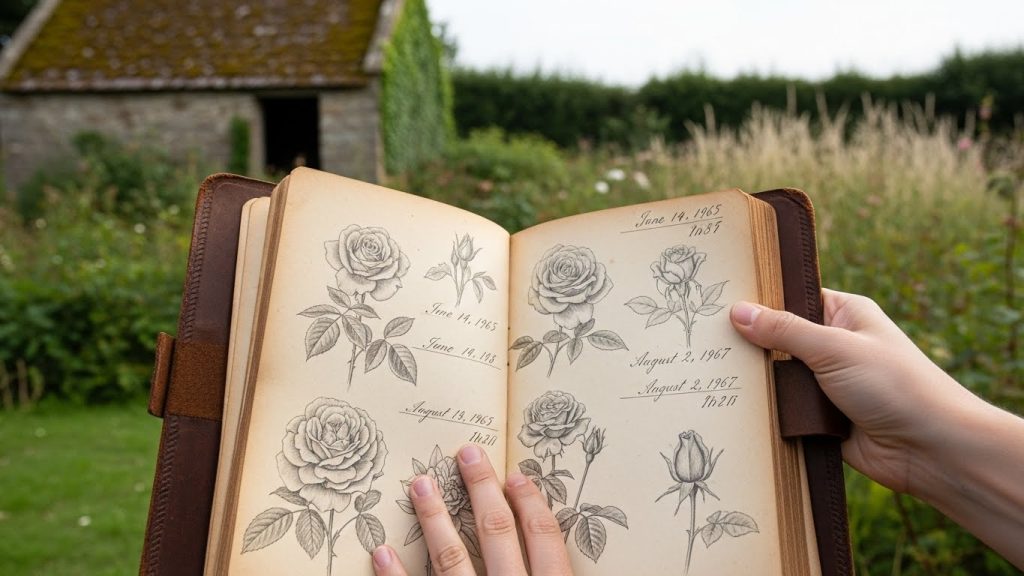
Needing fresh air, Elara went outside. The overgrown garden was a tangle of thorns and wild roses. An old stone shed sat at the edge of the cliff. Inside, amidst rusted shears and terracotta pots, she found a stack of journals.
They weren’t written in the script. They were gardening logs. Isolde had been meticulous about her roses.
June 12, 1968: The ‘Gloire de Dijon’ is blooming. The boy tries to touch the thorns. I pull him back. He cries. He does not understand that I am saving him from the bleed.
July 4, 1970: He speaks so much. Words tumble out of him like rocks. I cannot bear the noise of English. It is too sharp, too defining. It leaves no room for the things that are not quite true but not quite false.
Elara read on, mesmerized. Her grandmother wasn’t insane. She was hyper-sensitive. She viewed standard language as a cage, a crude tool that destroyed the nuance of emotion. To say “I love you” was to limit the feeling to a cliché. To say “I am sad” was to simplify a galaxy of grief into three letters.
So, she had built a better vessel.
Breaking the Cipher

Elara returned to the turret room with a new theory. The language wasn’t based on sound. It was based on emotion and nature.
She looked at the symbol that appeared most often in the “angry” section of the wall—a sharp, jagged rune that looked like a cracked mirror. She cross-referenced it with the gardening journal dates. On the days Isolde wrote about storms, or arguments with her husband, that symbol appeared on the wall.
She looked for the symbol for “son.” In the journals, Isolde referred to Elara’s father as “The Little Hawk.”
Elara scanned the East wall. There. A recurring symbol that looked like a bird in a dive.
It wasn’t a direct translation. It was an associative cipher. The Bird = Her Son. The Wave = Time. The Knot = Marriage. The Open Hand = Truth.
Elara began to construct a lexicon. It was slow, agonizing work, requiring her to think less like a scientist and more like a poet. She had to feel the weight of the ink.
The Story Unfolds
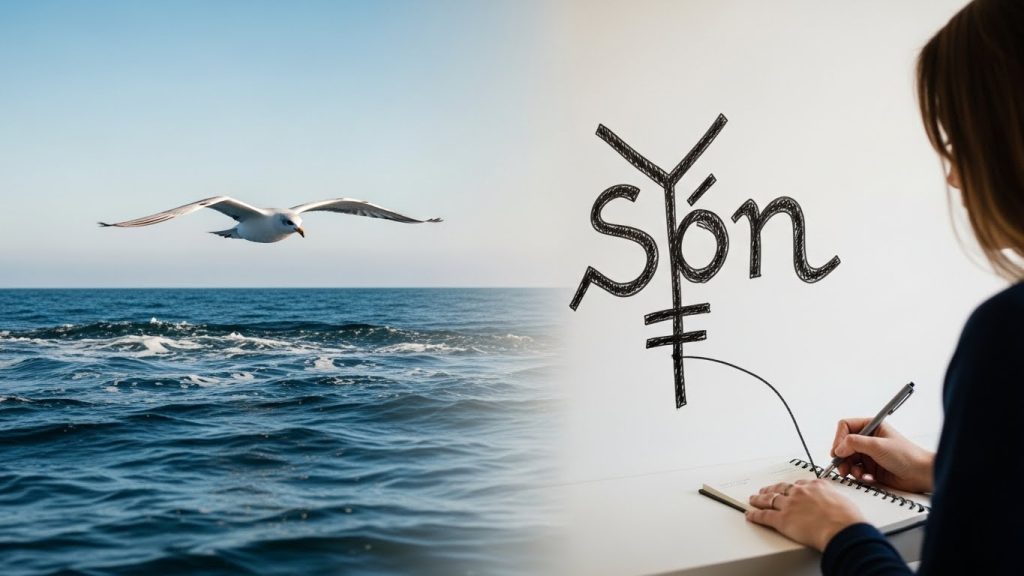
By the tenth day, Elara could read the sentences. She started at the beginning, the East Wall.
“The Hawk is born. He screams, and the world shatters. I have no words to give him that are not tainted by the lies of my fathers. So I will give him silence until I can build him a true voice.”
Elara walked slowly along the wall, reading the years of her father’s childhood.
“The Hawk grows. He brings me a stone. In English, it is just a ‘stone.’ In my tongue, it is ‘a piece of the earth that remembers the fire.’ I try to teach him, but he looks at me with fear. His father tells him I am sick. I am not sick. I am drowning in meaning.”
The tragedy unspooled. Isolde had tried to teach her son this language, this perfect way of communicating. But to a young boy, it was confusing and frightening. He wanted a mother who baked cookies and spoke plain English, not a sorceress who spoke in riddles and runes. He pulled away.
The writing on the South Wall—the teenage years—was jagged with heartbreak.
“The Hawk has flown. He leaves for the city. He says he suffocates here. He does not know that the air out there is thin, empty of magic. I have failed. The language remains spoken by only one. It is a song sung in an empty cathedral.”
The Secret of the West Wall
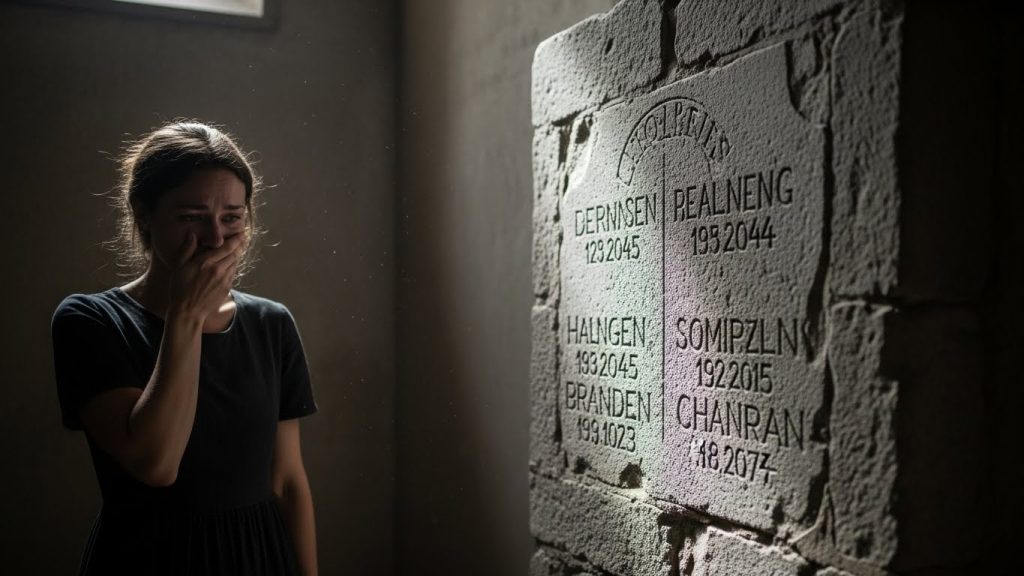
Elara reached the West Wall. The writing here was recent. The ink was barely dry in some places. This was written just before Isolde died.
The symbols here were different. They weren’t just recording the past; they were addressing the future.
“I feel the end coming. The Wave is rising to take me. But I have had a dream. A girl. The Hawk’s daughter. She is a seeker of patterns. She is a binder of loose threads.”
Elara stopped, her breath catching. Isolde knew about her.
“She will come when the Hawk is gone. She will find this room. If she is like the others, she will paint over it. But if she is of my blood—my true blood, the blood of the ink—she will listen.”
The text spiraled down to a single, final paragraph near the floor.
“To the Granddaughter I never held: Do not pity me. I lived a thousand lives in this room. But I leave you a warning. Language is a map, but do not mistake it for the territory. I spent so long drawing the map that I forgot to walk the land. Go outside. Touch the earth. Burn this room.”
The Choice
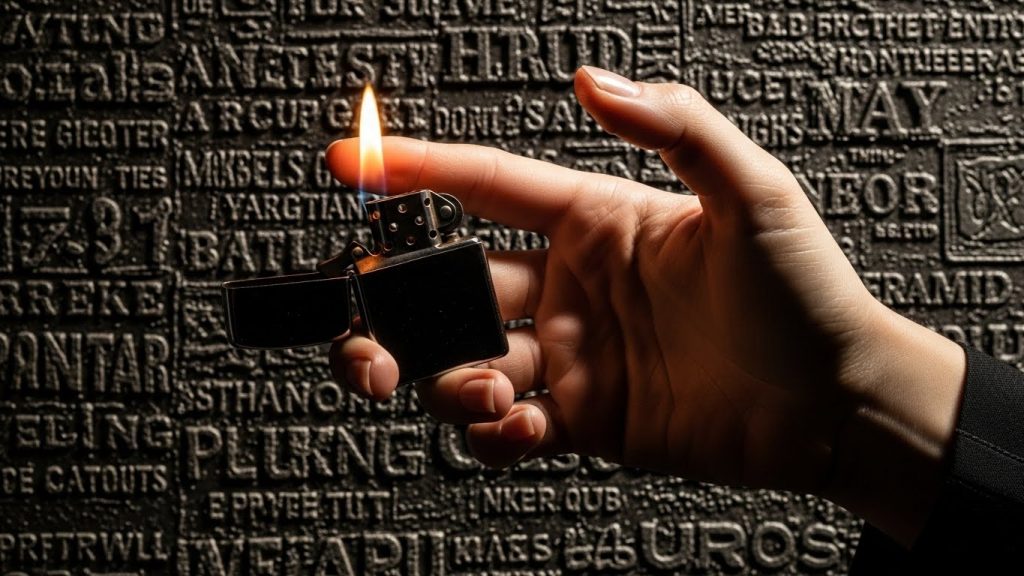
Elara sat on the floor, the translation complete. The “Silent Inheritor” wasn’t just her. It was the house itself, holding these words.
Isolde’s final command: Burn this room.
It was the plea of a woman who realized, too late, that her masterpiece was also her prison. She didn’t want Elara to be trapped by the same obsession. She didn’t want the legacy of the “perfect language” to become a burden.
Elara looked at her lighter. She looked at the dry, peeling wallpaper that framed the plaster. It would be so easy. A spark, and the obsession would be gone. She could sell the land, return to Chicago, return to her safe, structured life.
But she looked at the symbol for “Love” that Isolde had invented. It was a complex, beautiful glyph that combined the symbols for Root, Rain, and Pain. It was a more honest definition of love than Elara had ever seen in a dictionary.
The New Legacy

Elara stood up. She put the lighter away.
She wouldn’t burn the room. That would be erasing history, and she was an anthropologist. Her job was to remember.
But she wouldn’t live in it, either.
She walked to the window, the one painted shut for forty years. She took a small pry bar from her pocket and jammed it under the sash. With a grunt of effort, she heaved. The wood splintered, paint cracked, and the window flew open.
A gale of sea wind rushed in, chaotic and loud. It swirled around the turret, smelling of salt and decay and life. It fluttered the pages of Elara’s notebook.
She took a marker from her pocket—a thick, permanent black marker.
On the wall, right next to Isolde’s final, shaky period, Elara wrote in bold, blocky English letters:
I HEAR YOU. I AM LISTENING. BUT I AM GOING OUTSIDE NOW.
She turned her back on the walls. She walked out of the turret room and left the door wide open. She walked down the spiral stairs, through the gloomy foyer, and threw open the front doors of Hawthorn House.
She stepped out onto the gravel. The storm had broken. The sun was piercing through the clouds, illuminating the wet grass. Elara took a deep breath. She pulled her phone out and dialed her mother.
“Hey,” Elara said, her voice steady. “I’m coming home soon. But first, I have a story to tell you. It’s about a language only two people can speak, and I think… I think I’m going to teach it to the world.”
She walked toward the cliffs, the wind tangling her hair, leaving the silent house to finally, truly, speak.