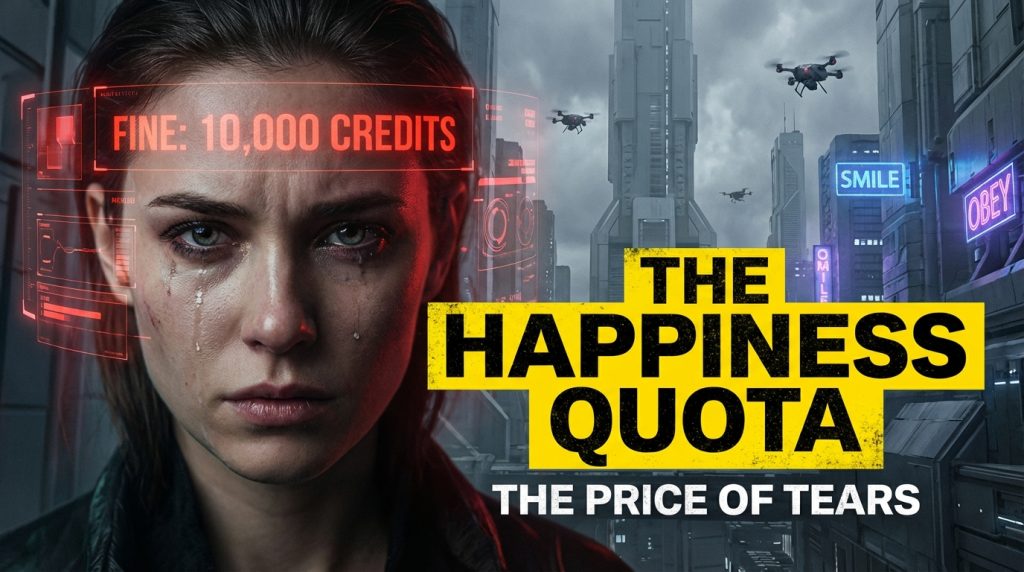
The Happiness Quota
Listen This Story
The first thing Elara heard when she woke up was not birdsong, but the sharp cha-ching of a notification from her wrist implant.
She opened her eyes, staring at the pristine white ceiling of her sleeping pod. A holographic display hovered in her vision:
DAILY MOOD AUDIT: 07:00 AM DETECTED STATE: Melancholy (Level 4) FINE APPLIED: 450 Credits. CURRENT BALANCE: -12,400 Credits.
Elara squeezed her eyes shut, fighting the urge to scream. Screaming was a “Class A Disturbance,” punishable by a 2,000-credit fine and mandatory chemical realignment. She couldn’t afford a Class A. She could barely afford to exist.
It had been thirty-two days since the accident. Thirty-two days since the mag-lev train malfunctioned and took David away from her. In the old world—the world her grandmother used to whisper about—a widow was allowed to mourn. Neighbors would bring casseroles; work would grant leave.
But this was New Arcadia, year 2094. The Golden Age of Productivity. The government had solved war, crime, and poverty by legislating the root cause: Negativity. The Happiness Quota was the law of the land. If you weren’t happy, you were a drain on the collective consciousness, and you had to pay for the pollution you caused.
The Morning Mask

Elara dragged herself out of bed. She walked to the bathroom mirror. The “Smart Mirror” didn’t show her reflection immediately; instead, it projected a filter over her face—rosy cheeks, sparkling eyes, a permanent, terrifying smile.
“Good morning, Citizen Elara!” the mirror chirped. “You look radiant! Suggestion: Raise your serotonin levels by visualizing a field of puppies!”
“Display actual face,” Elara whispered.
“Warning: Viewing unoptimized visage may trigger self-loathing tax. Proceed?”
“Proceed.”
The filter vanished. Elara looked at herself. Dark circles bruised her eyes. Her skin was gray. She looked like a ghost haunting her own life. She tried to force the corners of her mouth up. It felt like stretching old rubber.
She grabbed the bottle of “Joy-Vites” from the counter. Empty. She had taken the last three yesterday just to get through the funeral billing call. She threw the bottle into the recycling chute.
Clatter. DEDUCTION: 20 Credits (Frustration detected in object handling).
“Stop it,” she hissed at her wrist. DEDUCTION: 50 Credits (Verbal Aggression).
Elara stood still, breathing shallowly. It was a financial death spiral. The sadder she got, the poorer she became. The poorer she became, the more stressed she felt. The stress led to fines. The fines led to poverty.
The Commute

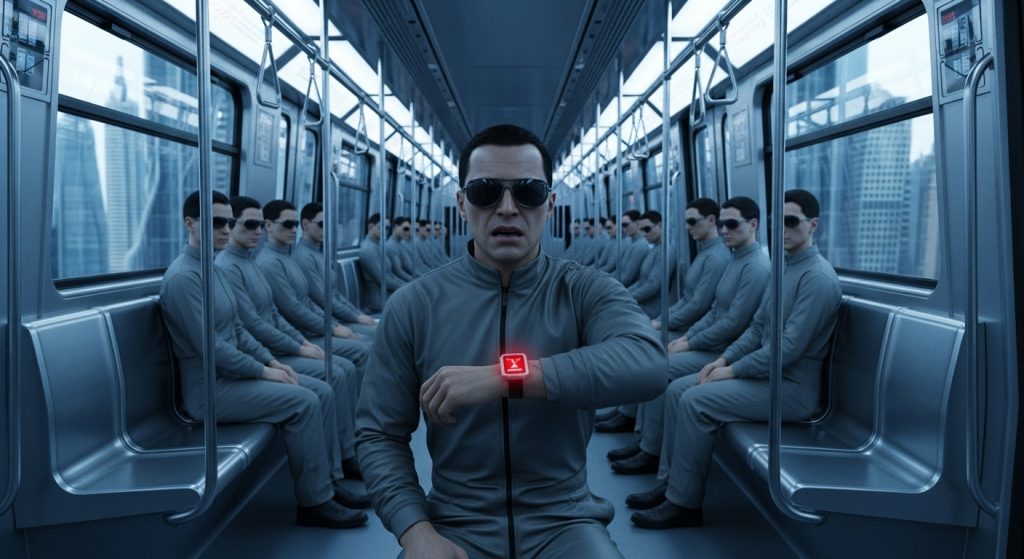
The commute to the Data Processing Center was a exercise in psychological warfare. The subway was a sea of rictus grins. Commuters sat shoulder to shoulder, staring ahead with wide, unblinking eyes. To frown on public transit was to risk a “Public Morale Infraction.”
Elara sat across from a man who was clearly weeping behind his sunglasses. He was shaking. Every few seconds, his wrist would flash red. Cha-ching. Cha-ching. He was bleeding money with every tear.
Elara looked away. Empathy was dangerous. “Sympathetic Resonance” was a taxable event. If she felt sad because he was sad, she would be fined too.
She pulled up a holo-book: The efficacy of Stoicism. She didn’t read it. She just stared at the words, thinking about David.
She remembered the way he laughed—a loud, ugly, wonderful snort that would have definitely incurred a “Noise Pollution” tax. She remembered the way he held her when she was anxious, whispering that it was okay not to be okay.
David would have hated this. He was the one who refused to get the implant until it became mandatory for employment. He used to say, “Grief is the price of love, El. If we can’t grieve, we never really loved.”
A single tear escaped Elara’s eye. She caught it with her thumb before the sensors could track the moisture.
The Eviction Notice
When she arrived at her cubicle, her terminal was flashing red.
PRIORITY MESSAGE: HOUSING AUTHORITY.
Elara’s heart hammered against her ribs. (Heart rate spike: Warning issued). She opened the message.
Dear Citizen Elara, Due to consistent failure to meet the Minimum Positivity Threshold (MPT) for three consecutive billing cycles, and failure to pay outstanding emotional debt, your housing lease has been flagged for termination. You have 24 hours to pay the balance of 12,400 Credits or vacate the premises. We recommend viewing our “Happy Homelessness” seminar for transition tips.
She couldn’t breathe. The apartment was the last thing she had of David. His smell was still in the closet. His half-finished painting was still in the spare room.
She couldn’t lose the house.
She checked her bank account. 400 Credits.
She needed 12,000. In 24 hours.
There was only one way to make that kind of money quickly. She had to sell the only commodity she had left.
She had to sell her memories.
The Memory Broker

The Memory Market was located in the lower levels of the city, where the biometric scanners were glitchy and the air smelled of ozone and desperation. Here, wealthy citizens—those who had chemically lobotomized themselves into permanent bliss—paid top dollar to experience “authentic” raw emotions. They bought sadness like it was a vintage wine.
Elara walked into a shop marked with a neon sign: CATHARSIS INC.
The broker was a greasy man with a customized implant that glowed illegal green.
“What are you selling?” he asked, not looking up from his datapad.
“Grief,” Elara said. “Pure, unprocessed grief. The death of a spouse. High potency.”
The broker looked up. His eyes widened. “Spousal loss? That’s rare these days. Most people take the amnesia pills immediately. Is it… raw?”
“I haven’t taken a single pill,” Elara said. “I feel every second of it.”
“Sit.”
He strapped a neural interface to her temples. “I can give you 15,000 credits for the full extraction. But you know the drill. Once I extract it, you lose the emotional connection. You’ll remember that he died, but you won’t care. It’ll be like reading a news article about a stranger.”
Elara gripped the arms of the chair. To save the house David lived in, she had to forget why she loved him. She had to sell the pain that proved he mattered.
The Choice

The machine hummed.
“Ready?” the broker asked.
Elara closed her eyes. She summoned David. The memory of their wedding day. The rain. The mud on her dress. The way he looked at her, soaked and shivering, and told her she was the most beautiful storm he’d ever seen.
She felt the ache in her chest. It was a heavy, crushing weight. It was terrible. It was precious.
15,000 credits. It would pay the fines. It would secure the apartment for a year. She could be numb. She could be safe. She could be a “Good Citizen.”
“Wait,” Elara said.
“Cold feet?”
“If I sell this,” Elara whispered, “who remembers him? Who carries the weight of his life?”
“Nobody,” the broker shrugged. “That’s the point. Lighten the load.”
Elara ripped the interface off her head. “No.”
“You walking away from 15k? You’re crazy, lady. You’re drowning.”
“I’d rather drown,” Elara said, standing up. “It’s my grief. I earned it.”
She walked out of the shop. DEDUCTION: 100 Credits (Irrational Behavior).
The Breakdown

Elara walked through the crowded streets. The sun was setting, painted a mandatory, cheerful pink by the atmospheric generators.
She had no money. She was going to lose her home. She was going to be thrown into the debtor’s prison, where they would force-feed her Joy-Vites until she was a drooling, smiling husk.
She stopped in the middle of the Central Plaza. A massive holographic statue of the “Prime Smiler”—the dictator who instituted the Quota—beamed down at her.
Around her, people rushed by, terrified of eye contact.
Elara felt a bubble rising in her throat. It wasn’t fear. It wasn’t sadness. It was rage. Hot, volcanic rage.
She started to laugh.
It started as a giggle. Then a chuckle. Then a full-throated, manic cackle that echoed off the glass skyscrapers.
People stopped. They stared. Their wristbands flashed warnings. proximity alert: deviant behavior.
“Stop laughing!” a woman hissed. “You’ll get us all fined!”
“Why?” Elara shouted. She spun around, arms wide. “Why are we doing this? Look at us! We’re terrified! We’re miserable!”
The Riot of Tears

A drone descended from the sky, its camera lens focusing on Elara’s face. A loudspeaker crackled.
“CITIZEN ELARA. CEASE THIS DISPLAY IMMEDIATELY. YOU ARE IN VIOLATION OF THE PEACE ACT. PREPARE FOR SANCTION.”
Elara looked at the drone. “Sanction this,” she screamed.
And then, she did the unthinkable. She fell to her knees in the middle of the plaza, in front of a thousand people, and she wailed. She screamed David’s name. She let the snot run down her face. She tore at her clothes. She unleashed thirty-two days of compressed, high-pressure grief.
FINE: 500 CREDITS. FINE: 1,000 CREDITS. FINE: 5,000 CREDITS.
The notifications scrolled across her vision like a waterfall. She didn’t care. It felt good. It felt real.
And then, something impossible happened.
The man with the sunglasses—the one from the subway—stopped. He looked at Elara. He looked at the drone. He pulled off his glasses. He started to cry. Ugly, loud sobs.
A woman dropping her groceries stopped. She sat down on the curb and buried her face in her hands, weeping for the mother she hadn’t been allowed to mourn five years ago.
The Chain Reaction

It spread like a virus. The “Sympathetic Resonance” that the government feared wasn’t a tax liability; it was a weapon. One person breaking the seal gave permission for the next.
Within minutes, the plaza was a cacophony of human emotion. People were screaming in anger at their bosses. Lovers were breaking up loudly. Strangers were hugging and sobbing.
The drones were confused. Their algorithms couldn’t process mass hysteria. They buzzed frantically, issuing fines that no one was reading.
FINE SYSTEM OVERLOAD. ERROR 404: EMOTIONAL BANDWIDTH EXCEEDED.
The giant holographic statue of the Prime Smiler flickered. The system couldn’t handle the influx of negative data.
Elara sat in the eye of the storm. She felt a hand on her shoulder. It was the subway man.
“Thank you,” he choked out. “I couldn’t hold it anymore. I just couldn’t.”
Elara smiled. A real smile. A sad, tired, genuine smile. “Me neither.”
The Arrest

The Joykeepers arrived in their white armored vans. They weren’t smiling. They wore gas masks and carried tranquilizer batons.
They waded into the crowd, subduing the crying rioters. Elara didn’t run. She stayed on her knees.
When two guards grabbed her arms, she didn’t fight.
“Citizen Elara,” the captain barked. “You have incited a Class 5 Emotional Riot. Your debt is now 4 million credits. You are sentenced to indefinite rehabilitation.”
They dragged her toward the van.
She looked back at the plaza. Half the people were being arrested. But the other half… they were running. They were smashing the biometric scanners. They were painting angry graffiti on the walls.
The facade had cracked.
The Debt of Love

Elara sat in the back of the containment van. Her wrist implant had been deactivated, severed from the network. The silence in her head was deafening.
She closed her eyes. She was going to prison. She would likely be wiped.
But as the van drove away, she summoned David one last time. She didn’t need the money. She didn’t need the apartment. She had the memory.
She pictured him smiling. Not the fake, mandated smile of New Arcadia, but his real smile—crooked, with coffee stains on his teeth.
“Worth it,” she whispered to the empty air.
She leaned her head against the cold metal wall of the van. For the first time in thirty-two days, she wasn’t afraid of the fine. She was bankrupt, imprisoned, and doomed.
But she was finally free.