The Piano in the Rubble
Listen This Story
The world ended on a Tuesday at 4:12 PM. It didn’t end with fire or a whimper, but with a roar that sounded like the earth itself was screaming.
Elias, a seventy-year-old watchmaker, had been under the sturdy oak frame of his workbench when the ceiling of his shop came down. He had lain there in the dark for what felt like hours, choking on dust that tasted of pulverized drywall and history. When the shaking finally stopped, replaced by an even more terrifying silence, he crawled out.
He emerged into a world he didn’t recognize. The neighborhood of San Lorenzo, a vibrant grid of brick row houses and corner cafes, was gone. In its place was a gray, jagged landscape of concrete waves and twisted rebar. The air was thick, hanging heavy and motionless, turning the afternoon sun into a hazy, blood-orange blur.
Elias stood on top of what used to be the bakery, coughing into his sleeve. He looked for landmarks. The clock tower? Gone. The grocer’s awning? Buried.
The Silence of the Aftermath

The silence was the worst part. Usually, a city hums. Now, there was only the occasional shifting of debris, the sound of glass tinkling as it fell from shattered windows, and the distant, muffled sobbing of survivors digging for their loved ones.
Elias stumbled down a mound of rubble into what used to be 4th Street. He was looking for anyone. He was looking for life.
That was when he saw it.
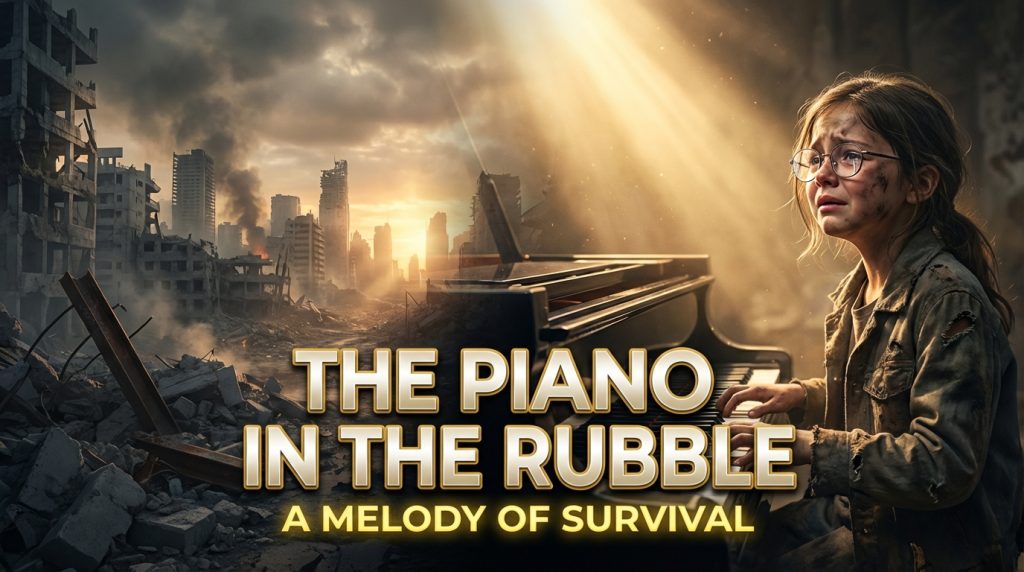
In the middle of the street, flanked by two mountains of debris that had once been apartment complexes, stood a miracle. It was a Steinway grand piano.
It wasn’t just there; it was pristine. The polished ebony surface gleamed in the twilight, reflecting the destruction around it like a dark mirror. It sat upright on its three legs, untouched by the chaotic violence that had leveled everything else. It looked like it had been gently placed there by the hand of God, a surreal centerpiece in a theater of war.
The Object of Absurdity

Elias approached it slowly, wary that it might be a hallucination caused by a concussion. He knew this piano. It belonged to Mrs. Gable, the eccentric widow who lived in the penthouse of the Stellar Building. The Stellar Building was now a heap of bricks. Gravity had pulled the building down, but somehow, through a physics-defying twist of fate, the floor had collapsed in a way that slid the piano out through a disintegrated wall and deposited it safely on the asphalt.
Elias ran a trembling, dust-caked hand over the lid. Cold. Smooth. Real.
“It shouldn’t be here,” a voice croaked.
Elias jumped. Emerging from the gray fog was Sarah, a young nurse who lived two blocks over. Her scrubs were torn, and she was clutching her left arm, which hung at an odd angle.
“Nothing should be here,” Elias whispered.
The First Note

They stood staring at the instrument. It felt disrespectful to touch it, like laughing at a funeral. But the silence of the ruins was becoming oppressive. It was a vacuum sucking the hope out of them.
“Does it work?” Sarah asked, her voice trembling.
Elias sat on the piano bench, which had miraculously landed upright next to the instrument. He lifted the fallboard. The keys were white and black grinning teeth, untouched by the dust.
Elias wasn’t a musician. He fixed gears and springs. He pressed a single key. Middle C.
Pinnnng.
The sound was pure, sharp, and shockingly loud. It cut through the thick air, echoing off the broken facades of the remaining buildings. It was the sound of order in a world of chaos.
The Gathering

That single note was a signal.
Slowly, like ghosts rising from the earth, people began to appear. A mother clutching a toddler covered in soot. The local butcher, still wearing his apron. A teenager with headphones around his neck, looking dazed.
They didn’t speak. They just walked toward the sound. They were drawn to the vibration, to the evidence that something delicate could survive something so violent.
Within ten minutes, twenty people were gathered around the piano in the rubble. They formed a ragged circle, united by shock and the black monolith in their midst.
“Play something,” a man whispered. It was Mr. Henderson, the cynical bank manager. He looked small now, stripped of his suit jacket, covered in gray ash.
“I… I can’t,” Elias said. “I only fix things.”
“I can,” a small voice said.
The Prodigy

A girl, no older than fourteen, stepped forward. It was Maya. Elias knew her; she took lessons from Mrs. Gable. Maya’s glasses were cracked, and her hair was matted with blood on one side, but she walked with a strange, trance-like purpose.
Elias stood up, offering her the bench.
Maya sat. She didn’t wipe her hands. She placed her dirty fingers on the pristine ivory keys. She closed her eyes, taking a deep breath that shuddered in her chest.
She began to play.
It wasn’t a complex classical piece. It was a simple melody—Gymnopédie No.1 by Erik Satie. Slow, melancholic, and achingly beautiful.
The Shift

The music drifted up, weaving through the twisted rebar and the broken concrete.
As Maya played, the atmosphere shifted. The shock—that freezing, numbing anesthetic—began to wear off. The music thawed them out.
Sarah, the nurse, slid down to the ground and began to weep. It wasn’t the hysterical screaming of earlier; it was a release. A deep, cleansing sorrow. The butcher put his arm around the bank manager. The mother rocked her child to the rhythm of the waltz.
For a moment, they weren’t victims of a disaster. They were an audience. The piano created a sanctuary, a circle of invisible light where the earthquake couldn’t reach them. It reminded them that beauty still existed, that human hands could create as well as destroy.
The Night Falls

The song ended. No one clapped. The silence returned, but it wasn’t empty anymore. It was filled with a shared connection.
Night began to fall, turning the gray world into pitch black. There was no electricity, no streetlights. The temperature dropped rapidly.
“We need a fire,” Elias said, his voice stronger now.
They mobilized. The piano had woken them up. The men gathered scrap wood from the ruins—splintered furniture, doorframes. They built a fire a few feet from the piano, careful not to damage it.
As the flames rose, casting long, dancing shadows against the wreckage, the scene took on a primal quality. They were the first humans again, huddled against the dark, finding comfort in the tribe.
The Aftershock

Then, the ground growled.
An aftershock.
It wasn’t as strong as the main quake, but to their traumatized nerves, it felt like the apocalypse returning. The ground rolled like a ship on the ocean. Debris cascaded down the nearby mounds.
Panic erupted. People screamed, scrambling to cover their heads.
“Stay down!” Elias yelled, covering Maya, who was still on the bench.
The shaking lasted ten seconds. When it stopped, the dust cloud choked the firelight.
“Is everyone okay?” Sarah shouted.
Coughs. Groans. “We’re okay.”
They looked at the piano. A large chunk of concrete had fallen from a nearby ledge. It had missed the piano by inches, cracking the pavement right next to the left leg.
The piano stood firm.
The Anchor

Maya sat up. Her hands were shaking violently now. She looked at the piano, then at the terrified faces around her.
She didn’t run. She put her hands back on the keys.
She played something different this time. Louder. Stronger. She played The Beatles’ “Let It Be.”
It was an act of defiance.
One by one, the neighbors joined in. They didn’t know all the words. Their voices were cracked and dry. But they sang.
” When I find myself in times of trouble…“
They sang to drown out the fear. They sang to tell the earth that they were still there. They sang for Mrs. Gable, who was likely buried beneath them.
The piano became more than an instrument; it was their anchor. In a world that was shifting and crumbling, the piano was solid. It was the only thing that made sense.
The Rescue

Dawn broke, bringing a pale, gray light to the devastation. The survivors were huddled together around the embers of the fire, leaning against the legs of the piano.
They heard it before they saw it.
A dog barking. Then, a whistle.
“Hello! Is anyone there?”
Rescue teams.
Elias stood up, his joints stiff. “Here! We are here!”
A team of firefighters in bright yellow gear crested the mountain of rubble. They stopped, staring down into the street. They saw the destruction, the hopelessness of the ruins. And in the center of it all, they saw a group of dirty, battered people standing around a shining, grand piano.
The lead firefighter slid down the debris. He looked at Elias, then at the piano.
“I’ve seen a lot of things,” the firefighter said, shaking his head. “But never this.”
They began the evacuation. It was slow and difficult. They had to leave the street.
Maya was the last to leave. She stood by the piano, running her hand along the keys one last time.
“We can’t take it,” Elias said softly, putting a hand on her shoulder.
“I know,” Maya said. “But it saved us.”
They climbed up the rubble, leaving the street behind.
Elias looked back one last time. The piano sat alone in the ruins, the morning sun catching the polished lid. It looked lonely, but it also looked victorious. It would eventually be ruined by the rain, or crushed by the cleanup crews. But for one night, The Piano in the Rubble had held the world together when it tried to fall apart.
As they walked toward the aid trucks, Elias thought he could still hear a faint melody on the wind, a promise that everything broken could, in time, be rebuilt.