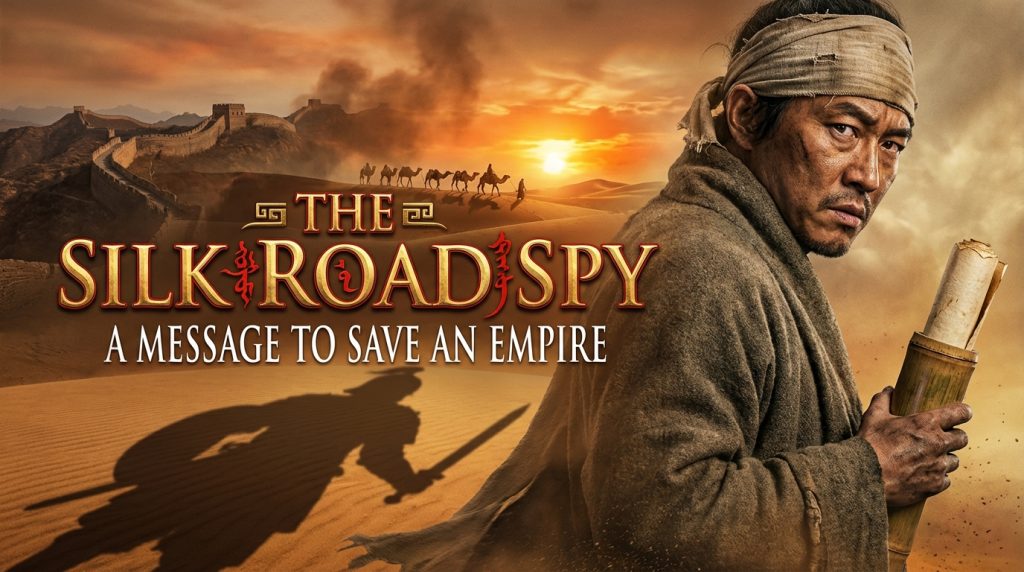
The Silk Road Spy
Listen This Story
The dust of Chang’an was golden in the morning light, masking the rot beneath the glory of the Tang Dynasty. Jian sat atop his camel, swaying with the beast’s rhythmic lurch, his face wrapped in a linen cheche to protect against the coming sun. To the world, he was merely a merchant—one of thousands leaving the eastern capital, his saddlebags heavy with bolts of raw silk, porcelain, and compressed tea bricks.
But the heaviest thing Jian carried weighed nothing at all.
Hidden inside the hollowed-out bamboo handle of a horsehair fly-whisk, tucked deep within his personal pack, was a strip of vellum no wider than a finger. On it were three lines of cipher. Those three lines proved that General Lu, the Guardian of the Western Frontier, had sold his loyalty to the encroaching Turkic Khaganate. If the Emperor did not receive this warning via the Persian diplomatic channels in Merv, the Western Gate would fall, the trade routes would be severed, and the empire would bleed out from its side.
Jian was not a soldier. He was a “Listener”—a shadow in the Emperor’s court. And he had three thousand miles of desert, mountains, and bandits between him and the Sassanid city of Merv.
The Departure

The caravan was massive, a serpentine beast of two hundred camels and fifty guards. The Caravan Master, a boisterous Sogdian named Rostic, shouted orders in a mix of broken Chinese and Persian.
“We move! The sands wait for no man!”
Jian kept his head down. He knew there were spies in the capital. The General’s reach was long. As the caravan passed through the massive city gates, Jian felt eyes on him. A beggar by the roadside? A guard checking permits too slowly?
He gripped the reins, his knuckles white. His cover was perfect: a mid-level trader seeking to expand his family’s textile business to the West. He had the backstory, the permits, and the goods. But fear is a scent, and Jian prayed the wind was blowing the other way. He wasn’t just leaving home; he was walking into the void.
The Jade Gate

Weeks turned into a month. The lush greenery of the east faded into the scrubland of the corridor. They reached the Yumen Pass—the Jade Gate—the final outpost of Chinese civilization before the vast emptiness of the Gobi. This was the first true test.
Captain Feng, a man with a jagged scar running through his left eyebrow, was inspecting the travelers. Feng was known for his cruelty and his loyalty to General Lu.
“Open the bags,” Feng commanded, tapping his sword against Jian’s camel.
Jian dismounted, bowing low. “Just silk, my lord. Finest quality. A gift for the Persian satraps.”
Feng sliced open a bale of silk with his blade. The fabric spilled out, shimmering like spilled water in the harsh sun. Feng poked through it, tossing the expensive cloth into the dirt. He moved to Jian’s personal pack.
He picked up the horsehair fly-whisk.
Jian’s heart hammered against his ribs like a trapped bird. He forced his breathing to remain steady. It’s just a whisk. A tool for the flies.
Feng twirled it. “Fancy handle for a fly swatter. Bamboo?”
“From the southern groves, my lord. A gift from my grandfather,” Jian lied, his voice steady.
Feng stared at him for a long beat, his eyes narrowing. He weighed the whisk in his hand. Then, he tossed it back into the dirt. “Move on. And pray the bandits leave you enough water to die slowly.”
The Sea of Death

They entered the Taklamakan Desert. The locals called it “The Sea of Death”—You go in, you do not come out.
The heat was a physical weight, pressing down on their shoulders like an iron yoke. The landscape was a monotony of shifting dunes, singing sands, and the bleached bones of camels that had failed the crossing. Time lost its meaning. There was only the sun, the sand, and the thirst.
Jian rode in silence. The isolation was both a blessing and a curse. It gave him time to think, but it also amplified his paranoia. He noticed a rider near the back of the caravan—a man with a scar on his cheek who never seemed to speak to anyone. Was he one of Feng’s men? Had Feng sent a shadow to follow the spy?
At night, under a canopy of stars so bright they looked like diamond dust, Jian slept with one hand on his dagger. He dreamed of the General’s armies burning Chang’an. He dreamed of the fly-whisk breaking open, spilling blood instead of paper.
The Sandstorm

On the tenth day in the desert, the sky turned a bruised purple. The wind died, leaving an eerie silence that made the camels nervous.
“Black Buran!” Rostic screamed, pointing to the horizon. “Cover the beasts!”
The sandstorm hit with the force of an avalanche. It wasn’t just wind; it was a wall of abrasive grit that scoured skin and blinded eyes. Jian pulled his camel to the ground, huddling against its flank, pulling his heavy wool cloak over his head.
For six hours, the world was nothing but screaming wind and darkness. The sound was deafening, a thousand demons shrieking at once.
When it finally cleared, the landscape had changed. Dunes had moved. And the caravan was scattered.
Jian dug himself out of the sand, coughing up grit. He checked his pack. The fly-whisk was safe. But as he looked at the horizon, he saw the caravan regrouping miles away. And he saw the man with the scar riding away from the group, heading west alone. He was riding ahead. To set a trap.
The Oasis Trap

Jian pushed his camel to the limit, bypassing the caravan to reach the oasis of Kashgar, a bustling hub where the Northern and Southern Silk Roads met. It was a riot of noise, smell, and color—a confusion of languages and goods.
He needed to switch tactics. Rostic was too slow.
He found a tea house in the shadows of the city wall. He was meeting a contact—a local silk dyer named Al-Hassan who would smuggle him into the next leg of the journey.
Al-Hassan arrived, looking nervous. He slid a cup of tea to Jian, his fingers stained indigo.
“The road west is closed,” Al-Hassan whispered, refusing to meet Jian’s eyes. “General Lu has sent word. They are looking for a thief who stole a royal jewel.”
“A jewel,” Jian scoffed softly. “That’s the cover story.”
“They have a description, Jian. They know about the fly-whisk.”
Jian froze. Feng. He must have realized the weight of the bamboo was wrong after the caravan left the Jade Gate. The man with the scar had ridden ahead to warn the patrols.
“You need to leave the whisk,” Al-Hassan said, his eyes darting to the door. “Give it to me. I will hide it.”
Jian looked at Al-Hassan’s hands. They were shaking. And there, on the table, reflected in the dark tea, Jian saw the signal—three soldiers waiting outside the door in the reflection of the brass pot.
Al-Hassan had sold him out.
The Escape

Jian didn’t hesitate. He threw the hot tea into Al-Hassan’s face. The dyer screamed, clutching his eyes.
Jian flipped the heavy table and bolted for the back exit. The soldiers burst in, swords drawn. Jian scrambled up a stack of crates and onto the clay roof of the tea house.
He ran across the rooftops of Kashgar, leaping over alleyways where merchants hawked spices and slaves. Arrows whistled past his ears. He was no longer a merchant; he was a hunted animal.
He dropped down into a stable, startling a groom. He threw a bag of coins at the boy and stole a fresh horse—a fast Ferghana stallion. He galloped out of the city gates just as the portcullis began to close, the iron teeth scraping the air inches behind his horse’s tail.
He didn’t look back. He was alone now. No caravan. No protection. Just a man, a horse, and a message.
The Roof of the World

To avoid the patrols on the main road, Jian took the high pass through the Pamir Mountains. The “Roof of the World.”
The heat of the desert was replaced by bone-chilling cold. The air was thin, making every breath a struggle. The path was a narrow ledge carved into the side of sheer cliffs, with a drop of thousands of feet into the misty abyss below.
His horse struggled. On the third day of the climb, the stallion slipped on black ice. Jian threw himself off the saddle just in time, grabbing a jagged rock. He watched in horror as the magnificent beast tumbled silently into the white fog below.
He was on foot.
He wrapped his furs tighter and walked. He hallucinated from the altitude. He saw his wife waiting for him in the snow. He saw the Emperor offering him warm wine. He kept walking, one foot in front of the other, fueled only by the terrifying importance of the vellum in his pack. If he stopped, the empire died.
The Hunter

He descended from the mountains into the Sassanid territory, half-dead, frostbitten, and starving. He was in Persia now, but he wasn’t safe.
He sensed the hunter before he saw him.
It was Feng. The Captain had not given up. He had tracked Jian across the desert and over the mountains, driven by the promise of a promotion and the General’s gold.
Jian was camping in the ruins of an old Zoroastrian fire temple when Feng stepped out of the shadows, moonlight glinting off his dao blade.
“You are a hard man to kill, merchant,” Feng said, his voice raspy.
Jian stood up, his legs shaking. He drew his own small dagger. It looked like a toy against Feng’s sword.
“The message ends here,” Feng snarled, lunging.
Jian didn’t try to block. He dodged, rolling over the ancient stones. He was weaker, but he was desperate. He threw a handful of ash from his fire into Feng’s eyes.
Feng roared, swinging blindly. Jian scrambled up a crumbling pillar. He waited. As Feng wiped his eyes, looking for his prey, Jian jumped.
He didn’t aim for the man. He aimed for the loose keystone of the archway Feng was standing under.
Jian’s weight brought the stone down. The archway collapsed, burying the Captain under a ton of ancient sandstone. The hunter was silenced.
The Arrival in Merv

Jian limped into the city of Merv. He looked like a beggar, a ghost made of dust and dried blood. The city was magnificent, a jewel of the desert, but Jian saw none of it.
He made his way to the Governor’s palace. The guards crossed their spears, blocking his path.
“Be gone, wretch,” they spat.
“I have… a gift… for the Emperor of China… from the West,” Jian rasped, using the code phrase.
He pulled the fly-whisk from his tattered robes. With trembling fingers, he unscrewed the bamboo handle. He pulled out the vellum.
The guards looked at the seal on the vellum—the Imperial Vermilion mark. Their eyes went wide. They opened the gates.
The Cost of Silk

Jian sat in a velvet chair, a cup of wine in his hand. The message had been sent. The Persian Governor had dispatched his fastest riders to the Tang Emperor’s court using the diplomatic relay. The treacherous General would be arrested within the week. The invasion would be stopped before it began.
Jian had saved the empire.
He looked at his hands. They were scarred, burned by the sun, bitten by the frost. He touched the empty handle of the fly-whisk.
A diplomat approached him, smiling. “The Empire owes you a debt, Jian. You will be rewarded. Gold. Land. Whatever you desire. A carriage awaits to take you home to Chang’an.”
Jian looked out the window at the setting sun, looking East toward home. He realized the truth. The General had allies. The General had spies. Even with Lu gone, the network remained. If Jian returned to Chang’an, he would be silenced before he could spend a single coin.
He was a hero to the history books, but a dead man to his home.
“I desire nothing,” Jian said softly, setting the cup down. “I am just a silk merchant. And the road calls.”
He stood up, leaving the luxury of the palace. He walked into the bustling market of Merv, disappearing into the crowd, a ghost once more. The Silk Road Spy had finished his mission, but his journey—the endless, wandering journey of a man who knows too much—was just beginning.