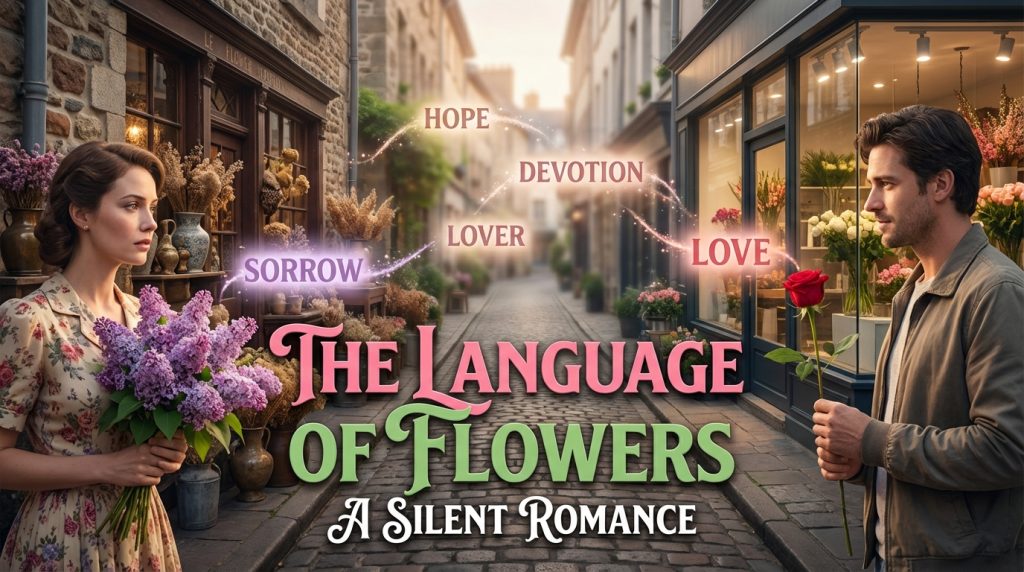
The Language of Flowers: A Silent Symphony
Listen This Story
The bell above the door of The Gilded Petal jingled, a sound that usually brought a smile to Elara’s face. Today, it brought a grimace.
Elara was a purist. Her shop, nestled in the cobbles of the Old Quarter, smelled of beeswax, dried lavender, and history. She didn’t just sell flowers; she curated sentiments. She knew that a yellow rose meant jealousy, not friendship, and she would sooner die than put a striped carnation in a wedding bouquet (refusal).
But across the narrow street, the enemy had arrived.
A new shop had opened. L’Art de la Fleur. It was sleek, modern, and horrifyingly minimalist. The owner was a man named Julian. He was tall, often covered in apron smudge, and possessed a smile that Elara found irritatingly disarming.
The problem wasn’t just the competition. It was the barrier.
On the day he opened, Elara had marched over to set some ground rules about delivery zones.
“Excuse me,” she had said, standing in his pristine white foyer. “I believe your delivery van is blocking my loading bay.”
Julian had looked up from a bucket of hydrangeas. He smiled and unleashed a rapid-fire stream of beautiful, lyrical, and utterly incomprehensible French.
“Je suis désolé, je ne parle pas anglais,” he had finished, shrugging with a charm that made Elara’s teeth ache.
He didn’t speak English. She didn’t speak French. They were neighbors, rivals, and strangers, separated by twelve feet of cobblestone and a linguistic chasm.
The First Volley

The war began on a Tuesday. Elara arrived at her shop to find a small pot sitting on her doorstep. It was a single, vibrant Basil plant.
To the uninitiated, it was an herb. To Elara, who lived and breathed the Victorian Language of Flowers, it was an insult.
Basil: Hatred.
Her jaw dropped. The audacity! He was declaring war.
She marched into her shop, her blood boiling. If he wanted to speak in petals, she would scream in blooms. She grabbed a handful of Tansy (Hostility) and wrapped it aggressively in brown paper. She marched across the street, slammed it onto his counter while he was with a customer, and marched out.
She watched from her window. Julian opened the paper. He looked at the Tansy. He looked across the street at her. And then, he laughed.
The Correction

An hour later, a delivery boy ran across the street with a response. It was a single Purple Hyacinth.
Elara stared at it. Purple Hyacinth: Please forgive me. I am sorry.
She frowned. Why was he apologizing? She looked back at the Basil plant on her step. She looked closer. It wasn’t common Basil. It was Holy Basil.
Holy Basil: Best Wishes.
Elara felt the heat rise in her cheeks. He hadn’t sent Hatred. He had sent a blessing for her shop. She had responded with Hostility, and he had responded with an apology for the misunderstanding.
She sank into her chair. “I am an idiot,” she whispered.
The Truce

She needed to fix this. She couldn’t walk over there and apologize; the language barrier was too thick, and her pride was too fragile.
She went to her cooler. She selected a White Tulip (I ask for forgiveness) and a sprig of Olive (Peace). She tied them with a simple silk ribbon and left them on his counter while he was in the back.
The next morning, she found a small vase on her windowsill. Inside was a White Clover (Think of me) and a Pear Blossom (Affection).
Elara touched the delicate petals of the pear blossom. It was a tentative step. A question asked in silence.
The Conversation Begins

Over the next month, the street became a conduit for a silent, fragrant conversation. They didn’t wave. They didn’t try to shout over the traffic. They simply left arrangements.
When it rained for a week straight and the street was empty, Julian sent Goldenrod (Encouragement). When Elara pricked her finger on a thorn and had to wear a bandage, Julian sent Healing balm (Sympathy).
Elara found herself waking up earlier, excited not just for the blooms, but for the message. She began to learn him. He wasn’t the arrogant modernist she thought. He was sensitive. He had a wit that came through in his choices—sending Mint (Virtue) after she caught him sweeping her side of the sidewalk.
The Depth of Sorrow

One rainy Tuesday, Elara didn’t open her shop. It was the anniversary of her mother’s death, the woman who had taught her the language of flowers. Elara sat in the dark of her shop, the “Closed” sign turned outward.
She saw Julian across the street. He was pacing. He looked at her dark shop window.
He disappeared into his back room. Minutes later, he was at her door. He didn’t knock. He simply set a large, heavy vase down and retreated.
Elara opened the door.
It was a stunning arrangement, heavy and somber. Weeping Willow (Mourning). Dark Crimson Rose (Mourning). Snowdrop (Hope).
Elara wept. He didn’t know why she was sad—he couldn’t possibly know the date—but he felt her sadness. He had sensed the shift in the air. He was speaking to her grief without saying a word.
The Barrier

The next day, Elara walked across the street. She wanted to say thank you. She wanted to hear his voice, even if she couldn’t understand the words.
She entered L’Art de la Fleur. Julian was arranging lilies. He looked up, his eyes lighting up.
“Elara,” he said. It was the first time he had spoken her name. It sounded like a song in his accent.
“Thank you,” she said, pointing to the spot where the willow had been.
“De rien,” he whispered.
They stood there, surrounded by the scent of a thousand flowers, trapped in the silence. There was so much she wanted to say. She wanted to ask about his family, his dreams, why he came to this city. But the words died in the air.
Frustration bubbled up. It was a cruelty to be so connected in spirit and so severed in speech.
She turned and left, the bell jingling a melancholy tune.
The Threat

Summer turned to Autumn. The leaves on the cobbles turned gold.
One morning, Elara saw a man in a suit enter Julian’s shop. He carried a briefcase. He looked like a landlord. Or a developer.
He was in there for an hour. When he left, Julian looked defeated. He sat on a stool, his head in his hands.
Elara waited for a message. None came. Day 1 passed. No flowers. Day 2 passed. Nothing.
Elara couldn’t stand it. She sent a Butterfly Weed (Let me leave you / Go away). No, that’s wrong. She threw it in the bin.
She sent Columbine (Anxiety).
Julian didn’t respond. He was packing boxes.
The Misunderstanding

Panic set in. He was leaving. The shop was closing. The landlord must have raised the rent, or perhaps he was moving back to France.
Elara felt a breaking in her chest she hadn’t anticipated. She realized that she didn’t just tolerate the rival across the street. She needed him. He was the only person in the world who spoke her language—the true language.
She had to stop him. But how?
She crafted the most important arrangement of her life. Purple Lilac (First emotions of love). Heliotrope (Devotion). Forget-Me-Not (True love).
She ran across the street. The shop was empty. The door was locked. A sign in the window read FERMÉ.
He was gone.
The Chase

Elara stood on the sidewalk, the bouquet heavy in her arms. The rain began to fall. She had missed him. She had spent so much time decoding petals she had forgotten to act.
She turned to go back to her shop, defeated.
Then she saw it.
Sitting on her doorstep, sheltered from the rain by the awning.
A massive, singular flower pot.
She ran to it.
It wasn’t a bouquet. It was a potted plant. A young tree, actually.
It was a Myrtle tree.
In the Victorian language, Myrtle has one specific, powerful meaning: Love and Marriage. It is the flower of the Hebrew bride.
Tucked into the soil was a note. It wasn’t in French. It was in broken, painstakingly written English.
“I bought the building. I am not leaving. I am staying. For you. Teach me English?”
The Bloom

Elara looked up. Julian was standing in the window of his “closed” shop, watching her. He looked terrified. He had gambled everything on a tree and a sentence.
Elara dropped her bouquet of lilacs and heliotrope on the ground—not in rejection, but in haste.
She didn’t send a flower back.
She ran across the street. She pounded on the glass.
Julian unlocked the door.
Elara didn’t say a word. She couldn’t finding the meaning for “I thought I lost you and I love you and yes I will teach you English.”
So she reached up, grabbed the lapels of his apron, and kissed him.
It turns out, there is one language that predates even the Victorians.
When they broke apart, breathless, Julian smiled. He pointed to the bouquet she had dropped on the sidewalk, the Lilacs and Forget-Me-Nots now soaking in the rain.
“Pour moi?” he asked.
“For you,” Elara said.
Julian picked a single Red Camellia from a bucket next to him and tucked it behind her ear. You are a flame in my heart.
Elara laughed. “We have a lot of talking to do.”
“Yes,” Julian said, taking her hand. “But first… coffee?”
And for the first time, Elara didn’t need a dictionary to understand him perfectly. The Language of Flowers Story had ended, and the conversation of a lifetime had begun.